Road Trip Prep: The Checklist That Prevents the Common Failures
Long drives rarely fail because of exotic problems. They fail because of tires, cooling, and batteries, roughly in that order, and all three are checkable in advance.
A week before
Give yourself enough runway that a discovered problem is an appointment rather than a crisis.
- Tires, including the spare. Check pressure cold, inspect tread and sidewalls, and confirm the spare is inflated. A flat spare is a common and infuriating discovery. Locate the jack and lug wrench and confirm the tools are actually present.
- Cooling system. Check coolant level and look for crusty residue at hose joints. Heat and sustained highway speed are exactly what expose a marginal cooling system.
- Battery. Test it if it is more than three years old.
- Oil and filter. If you are within a couple thousand miles of the interval, do it before rather than during.
- Brakes. Address any noise or pulsing now. A mountain descent is the wrong place to learn about brake condition.
The day before
- Top off washer fluid and check wipers. Bug splatter at highway speed is a real visibility issue.
- Confirm all lights work, with someone watching the brake lights.
- Clean the windshield inside and out. Interior film creates severe glare at sunrise and sunset.
- Download offline maps. Coverage gaps are common in exactly the places where you need directions.
What to actually carry
Skip the enormous kit that lives in the trunk unopened. These earn their space:
- Jumper cables, or better, a compact lithium jump pack that needs no second vehicle
- A twelve-volt tire inflator and a plug kit
- A flashlight with working batteries
- Basic first aid supplies
- A gallon of water, useful for people and cooling systems alike
- Chargers and a power bank
- Paper directions to your destination, for when the phone fails
Plan the driving, not just the route
Fatigue is the underestimated risk. Rotate drivers every two to three hours if you can, stop at least every two hours regardless, and be honest that the last hour of a long day is where mistakes concentrate. Arriving ninety minutes later is a trivial cost.
Traveling with children or pets means planning stops around them rather than around fuel, since those come more often.
Pack so the car still handles
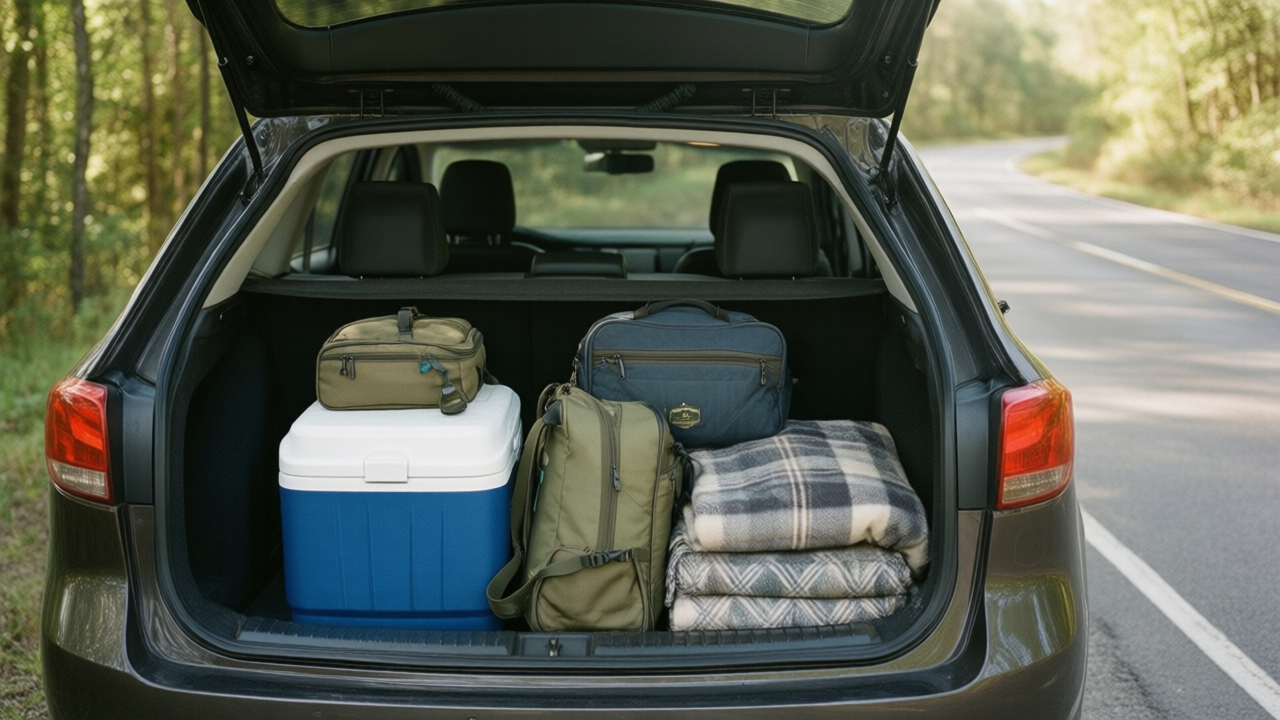
Heavy items go low and forward of the rear axle. A high, rearward load raises the center of gravity and makes an emergency maneuver less predictable. Do not stack cargo above the seat backs where it can become a projectile, and keep the rear window and mirrors usable.
If you are near the vehicle's load capacity, check the door-jamb sticker for the recommended pressure adjustment when loaded.
On the road
Fuel up at half a tank rather than a quarter in unfamiliar or remote areas. Note how the car sounds and feels early in the trip so a change stands out. If something starts making a new noise, stopping to look costs fifteen minutes, while continuing can cost the trip.
Article Was Generated By AI.